
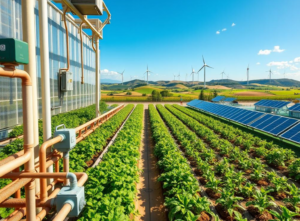
Urban farms now consume up to 50 times more energy per square foot than traditional outdoor agriculture. This striking difference reveals why renewable energy has become essential for the future of vertical farming and sustainable urban agriculture in America’s growing cities.
Cities worldwide face a critical challenge. Population growth continues to surge, with experts predicting that nearly 70% of the world’s population will live in urban areas by 2050. This shift creates urgent demand for local food production. Traditional farming methods cannot meet these needs from distant rural locations. Vertical farm energy efficiency offers a practical solution for this urban food crisis.
Indoor farming facilities use controlled environment agriculture to grow crops year-round. They regulate temperature, humidity, and lighting to maximize plant growth. These operations demand constant power input. Without renewable energy sources, vertical farms rely heavily on fossil fuels, which contradicts their sustainability goals.
Renewable energy transforms how vertical farms operate. Solar panels, wind turbines, geothermal systems, and biomass conversion technologies can power these facilities cleanly. By combining these sources with advanced battery storage, farms reduce operational costs while cutting carbon emissions significantly.
Sustainable urban agriculture delivers multiple benefits beyond food production. It shortens supply chains, reduces transportation emissions, and strengthens community food security. When powered by renewable energy, vertical farms become models of environmental responsibility.
This article explores how clean energy technologies power the next generation of agriculture. From solar integration to geothermal heating, each renewable source plays a vital role in making vertical farm energy efficiency a reality for American cities.
The Rise of Urban Agriculture and Its Energy Demands
Cities across America are transforming into food-producing centers. Urban agriculture has shifted from hobby gardens to serious farming operations. This movement addresses real problems including food supply chain vulnerabilities, environmental concerns, and the need for fresh produce in densely populated areas. Modern urban farms range from simple rooftop gardens to complex vertical farming facilities that use advanced technology to grow crops year-round.
The growth of urban farming reflects changing attitudes about food production. Communities want control over their food sources. Climate change and transportation costs push farmers to grow closer to where people live. These factors create opportunities for innovative growing methods in cities.
Understanding the Urban Farming Revolution
Urban farming takes many forms. Rooftop gardens use existing building space. Hydroponic systems grow plants without soil using nutrient-rich water. Aquaponics combines fish farming with vegetable production. Vertical farms stack crops in tall buildings, maximizing space in small urban areas.
These farming models serve communities with fresh vegetables and herbs. They create jobs and bring green space to concrete neighborhoods. Urban farmers can harvest crops in days rather than months, providing consistent local food supplies.
Energy Consumption Challenges in Controlled Environment Agriculture
Controlled environment agriculture requires significant power. This farming method creates ideal growing conditions indoors but demands constant energy input.
- LED grow lights operate 12 to 18 hours daily
- HVAC systems maintain proper temperature and humidity
- Water circulation pumps deliver nutrients to plants
- Monitoring equipment tracks growing conditions
Energy costs create major challenges. Controlled environment agriculture facilities consume 10 to 20 times more energy per square foot than traditional outdoor farming. Energy expenses can represent 25 to 30 percent of total operating costs in vertical farms.
Energy efficient farming practices become essential for business success. Without renewable energy solutions, urban farms struggle financially. This reality drives farms to explore solar power, wind energy, and other sustainable options to reduce costs and improve profitability.
Solar Power Integration for Indoor Farming Operations
Solar powered indoor farming represents one of the most practical approaches to renewable energy systems for urban agriculture. Solar photovoltaic technology offers farmers an accessible path toward energy independence. The sun provides a consistent power source that aligns well with the needs of controlled environment farming.
Different installation methods work for various farming spaces. Urban farmers can choose from several options to fit their specific situations:
- Rooftop-mounted panels on warehouse and greenhouse structures
- Building-integrated photovoltaics installed directly into building surfaces
- Solar canopies positioned above outdoor growing areas
- Ground-mounted arrays for larger agricultural facilities
Designing an effective solar powered indoor farming system requires careful planning. Farmers must calculate their energy consumption based on lighting, climate control, and irrigation needs. South-facing orientation in the Northern Hemisphere captures maximum sunlight. Panel tilt angles should match the farm’s latitude for optimal performance.
Solar panel technology has improved significantly. Three main types exist in today’s market:
| Panel Type | Efficiency Rating | Space Requirements | Cost Level |
|---|---|---|---|
| Monocrystalline | 18-22% | Lower space needed | Higher initial cost |
| Polycrystalline | 15-18% | Moderate space needed | Mid-range cost |
| Thin-film | 10-15% | Higher space needed | Lower initial cost |
Net metering allows farms to send excess solar energy to the grid during peak production hours. Farmers draw power back when solar output drops. This arrangement creates financial benefits and grid stability.
Solar renewable energy systems offer long-term value. Quality panels last 25 to 30 years with minimal degradation, typically declining about 0.5% annually. Maintenance needs remain low, mainly requiring occasional cleaning. Installation costs have dropped dramatically over the past decade, making renewable energy systems increasingly attractive for agricultural operations pursuing sustainability goals.
Wind Energy Applications in Urban Agricultural Settings
Wind power represents a valuable complement to solar renewable power systems in urban farming environments. While solar panels capture energy during daylight hours, wind turbines generate electricity throughout the day and night. This combination creates more balanced energy production across seasons. Wind speeds often peak during evening hours and winter months when solar output naturally declines. By integrating wind energy into urban agricultural operations, farmers can reduce their dependence on grid electricity and battery storage systems.
Urban wind energy presents distinct challenges compared to rural wind farms. Buildings and structures create turbulent wind patterns that make consistent energy generation difficult. Zoning restrictions, noise ordinances, and vibration concerns also limit placement options. Understanding these constraints helps determine whether green energy solutions involving wind power make sense for your specific location.
Micro-Wind Turbines for Rooftop Farms
Small-scale wind turbines designed for rooftops offer practical solutions for urban growers. Vertical-axis wind turbines (VAWTs) work better in turbulent urban conditions than traditional horizontal-axis designs. VAWTs spin like eggbeaters and capture wind from any direction, making them ideal for locations surrounded by buildings.
Before installing any turbine, conduct a thorough site assessment. This process includes:
- Monitoring wind speeds for at least one month using an anemometer
- Analyzing prevailing wind directions from your rooftop location
- Confirming minimum wind speeds of 10 miles per hour for viable generation
- Checking local zoning regulations and building codes
- Evaluating noise levels and vibration impacts on neighboring properties
Hybrid Wind-Solar Systems for Maximum Efficiency
Combining wind and solar technologies creates renewable power systems that work year-round. Winter months bring stronger winds but weaker sunlight. Summer months bring the opposite. This natural balance reduces gaps in energy production throughout the year.
Hybrid systems require compatible equipment:
- Dual-input inverters that accept power from both sources
- Unified monitoring systems to track real-time energy production
- Coordinated battery charging strategies to maximize storage efficiency
- Smart controllers that optimize power flow between sources
Wind energy typically involves higher upfront installation costs compared to solar arrays. Payback periods generally range from 8 to 15 years depending on local wind resources. Despite longer initial investment timelines, wind power diversifies your renewable energy portfolio. When local conditions support wind generation, hybrid renewable power systems deliver superior long-term value for urban agricultural operations seeking comprehensive green energy solutions.
Renewable Energy Vertical Farming: A Sustainable Model
Renewable energy vertical farming represents a transformative approach to food production in urban environments. This integrated system combines vertical farming technology with clean energy sources to create sustainable agriculture that addresses multiple global challenges. Unlike traditional farms, renewable energy vertical farming operations use 90-95% less water through recirculating hydroponic and aeroponic systems, eliminate pesticide needs in controlled environments, and produce fresh crops year-round regardless of weather conditions.
The concept of energy-positive vertical farms stands at the heart of this sustainable model. These facilities generate as much renewable energy as they consume, offsetting their entire carbon footprint. Vertical farming technology incorporates automated climate control systems, LED lighting optimized for plant photosynthesis, nutrient monitoring systems, and integrated pest management protocols. Solar panels, wind turbines, and geothermal systems power these operations, making them truly self-sufficient agricultural centers.
Renewable energy vertical farming excels with specific crops suited to indoor environments:
- Leafy greens and lettuce varieties
- Fresh herbs and microgreens
- Strawberries and vine tomatoes
- Peppers and specialty vegetables
This model scales from small community operations to commercial facilities producing millions of pounds annually. The environmental benefits extend beyond water conservation to include elimination of agricultural runoff, preservation of natural ecosystems, reduced food transportation distances, and enhanced urban food security. Renewable energy vertical farming delivers practical solutions for feeding growing urban populations while protecting our planet’s natural resources.
| Feature | Traditional Agriculture | Renewable Energy Vertical Farming |
|---|---|---|
| Water Usage | 100% baseline | 5-10% of traditional |
| Land Required | Large ground areas | Minimal urban space |
| Pesticide Application | Frequent spraying | None required |
| Annual Harvests | 1-3 per year | Year-round continuous |
| Energy Source | Grid electricity | Renewable sources |
| Carbon Footprint | High emissions | Carbon-neutral or negative |
Vertical farming technology makes this sustainable model feasible through intelligent automation and precise environmental management. Smart systems monitor soil nutrients, light intensity, temperature, and humidity in real-time, optimizing growing conditions for maximum yield. When paired with renewable energy sources, these advanced systems eliminate the energy-intensive operations that traditionally burden indoor agriculture.
The scalability of renewable energy vertical farming demonstrates its viability as a mainstream food production solution. Cities worldwide increasingly adopt this approach to strengthen local food systems while reducing dependence on long-distance agricultural supply chains. From apartment rooftops to converted warehouses, renewable energy vertical farming transforms underutilized urban spaces into productive food sources.
Geothermal and Biomass Energy Solutions for Climate Control
Temperature control in vertical farms and urban agricultural facilities demands consistent energy input. Geothermal and biomass technologies offer reliable alternatives for clean energy agriculture that reduce operational costs while maintaining optimal growing conditions. These systems work by tapping into natural heat sources beneath the earth’s surface and converting waste materials into usable power.
Utilizing Ground Source Heat Pumps
Ground source heat pumps leverage the earth’s steady subsurface temperature to provide heating and cooling for indoor farms. At depths of 10 to 20 feet, soil maintains a constant temperature between 50 and 60 degrees Fahrenheit. This stable environment allows heat pumps to operate with exceptional efficiency, delivering 3 to 5 units of heating or cooling for every unit of electricity consumed.
Two main system types exist for implementing this technology. Closed-loop systems circulate fluid through buried pipes, while open-loop systems use groundwater directly. Installation depends on available space and soil conditions. Horizontal loop arrangements work well for farms with sufficient land area. Vertical boreholes provide space-saving alternatives for urban locations with limited ground access.
| System Type | Best For | Installation Time | Efficiency Rating |
|---|---|---|---|
| Closed-Loop Horizontal | Large rural farms | 2-4 weeks | COP 4.0-5.0 |
| Closed-Loop Vertical | Urban operations | 3-5 weeks | COP 3.5-4.5 |
| Open-Loop Groundwater | High water availability | 2-3 weeks | COP 4.0-5.0 |
Energy management agriculture improves significantly when heat pump systems integrate with existing HVAC infrastructure. Installation requires professional assessment of soil conditions, groundwater availability, and local regulations to ensure compliance and optimal performance.
Converting Agricultural Waste into Energy
Biomass energy transforms farm waste into valuable power sources. Anaerobic digestion systems convert plant waste, unused produce, and organic matter into biogas containing primarily methane. This gas can fuel generators for electricity or heating systems within agricultural facilities.
The process works through sealed tanks where microorganisms break down organic materials without oxygen. Facilities typically require minimum waste volumes of 5 to 10 tons daily for economically viable operations. Systems demand regular maintenance but deliver consistent energy output throughout the year.
- Anaerobic digesters process food waste and plant residue
- Composting heat recovery captures thermal energy from decomposition
- Biosolids from digestion serve as nutrient-rich fertilizer
- Reduced disposal costs through waste-to-energy conversion
These clean energy agriculture solutions create circular economy benefits. Waste products become energy inputs while reducing landfill burden. Permitting requirements vary by location, so farms should consult local authorities before installation. Both geothermal and biomass systems provide reliable energy management agriculture approaches that lower operational expenses and environmental impact simultaneously.
Battery Storage and Energy Management Systems
Renewable power systems depend on reliable energy storage to succeed in urban agriculture. Solar panels and wind turbines produce energy at unpredictable times, but farms need steady power around the clock. Battery storage fills this gap by storing excess energy for later use. This approach ensures that vertical farms and indoor growing operations stay productive even when sun and wind are absent.
Different battery technologies serve agricultural needs in distinct ways. Lithium-ion batteries offer high energy density and typically last 10 to 15 years, though they require larger upfront investment. Lead-acid batteries cost less initially but need more maintenance and fail sooner. Emerging technologies like flow batteries and solid-state designs promise better performance in coming years.
Sizing a battery system requires careful planning. Farmers must consider their daily energy use, how many hours they want backup power, and how deeply they can drain batteries without damage. Energy management agriculture depends on these calculations for success. Smart monitoring systems track this data constantly.
Smart Energy Management Systems
Modern energy management agriculture relies on intelligent control systems that optimize renewable power systems performance. These platforms monitor energy production and use in real time. They direct power first to critical functions like climate control, then schedule water pumping during peak solar hours. This strategy reduces waste and extends battery life.
Advanced systems offer additional benefits:
- Real-time monitoring of solar and wind output
- Automated battery charging and discharging schedules
- Demand response programs that reward farms for using less power during peak hours
- Time-of-use rate optimization that shifts work to cheaper periods
- Backup power during grid outages to protect crops
Smart grid integration connects farms to utility networks. Participating farms earn compensation by reducing electricity use when the grid experiences peak demand. This creates new income streams for renewable power systems operators.
Energy management agriculture transforms how farms operate. Storage systems and intelligent controls work together to maximize efficiency, reduce costs, and ensure crops grow safely regardless of weather conditions or time of day.
Economic Benefits of Renewable-Powered Vertical Farms
Investing in renewable energy for vertical farms creates real financial advantages. Farmers see lower operating costs, increased property values, and opportunities to earn money from green energy credits. The economic case for sustainable urban agriculture keeps getting stronger as energy prices rise.
Understanding the money side of renewable energy systems helps farmers make smart decisions. Several financial factors work together to build profitability over time.
Return on Investment and Payback Periods
Solar power systems in vertical farming typically pay for themselves in 5 to 8 years. Geothermal heat pumps take 7 to 12 years, while wind turbines need 10 to 15 years. These timelines depend on location, current energy costs, system size, and available tax breaks.
Vertical farm energy efficiency improvements directly boost profits. Every 1 percent gain in efficiency cuts operating costs immediately. A farm using renewable energy pays a fixed, predictable price instead of dealing with rising utility bills.
| Energy System Type | Typical Payback Period | Key Cost Factors |
|---|---|---|
| Solar Panels | 5-8 years | Installation costs, sunlight availability |
| Geothermal Heat Pumps | 7-12 years | Ground conditions, heating needs |
| Wind Turbines | 10-15 years | Wind resources, equipment expenses |
The levelized cost of energy shows how much each kilowatt-hour costs over a system’s lifetime. Renewable systems provide price certainty. Farms avoid utility rate increases that typically happen every year.
Government Incentives and Tax Credits
Federal tax credits cover a large share of renewable energy costs. The Investment Tax Credit (ITC) for solar systems currently gives a percentage of total installation expenses back as a tax credit. The Modified Accelerated Cost Recovery System (MACRS) lets farms write off renewable equipment faster.
Several government programs support sustainable urban agriculture development:
- USDA Rural Energy for America Program (REAP) offers grants and loan guarantees
- State-level incentives vary widely by location and crop type
- Local utility companies provide rebates for energy-saving upgrades
- Property tax exemptions exist in many areas for renewable systems
Beyond tax savings, renewable-powered farms gain market advantages. Consumers pay premium prices for sustainably grown produce. Farms can sell renewable energy credits back to the grid. Enhanced property values and stronger corporate sustainability records attract investors and partners.
Smart financial planning turns renewable energy from an expense into an investment that pays back year after year.
Case Studies: Successful Renewable Energy Urban Farms
Real-world examples show how solar powered indoor farming and energy efficient farming transform urban agriculture. These operations demonstrate that renewable energy integration works across different scales and locations. Each farm tells a unique story about overcoming challenges and building sustainable food systems.
Gotham Greens operates multiple solar powered indoor farming facilities across major U.S. cities. Their greenhouse systems combine rooftop solar panels with energy efficient farming techniques. The company grows leafy greens and herbs year-round while reducing their carbon footprint significantly. Their facilities achieve approximately 95% less water usage compared to traditional outdoor farming.
Brooklyn Grange runs one of the largest rooftop farming operations in North America. Located on industrial rooftops, the farm integrates renewable energy systems to power irrigation and climate control. Their 2.5-acre space produces over 50,000 pounds of vegetables annually while maintaining energy efficient farming practices. The operation demonstrates how urban spaces can become productive agricultural sites.
AeroFarms uses aeroponic growing systems combined with LED lighting powered by renewable sources. Their energy efficient farming approach cuts resource consumption dramatically. The company grows crops in vertical stacks, multiplying yields per square foot. Their facilities use 95% less water than field farming and eliminate pesticide needs entirely.
Community-scale projects prove that renewable energy vertical farming works for smaller operations too. Local organizations demonstrate these principles are accessible beyond large commercial ventures.
- Reduced energy bills by 60-80% after implementation
- Payback periods ranging from 5-8 years
- Year-round production capacity
- Minimal environmental impact
Success across these operations depends on strong technical expertise, adequate startup funding, direct market access, and commitment to continuous improvement. These farms inspire others to pursue solar powered indoor farming and energy efficient farming systems.
Future Innovations in Clean Energy for Agricultural Technology
The future of urban agriculture depends on breakthrough innovations that combine cutting-edge vertical farming technology with advanced green energy solutions. These emerging technologies promise to transform how we grow food in cities while reducing our dependence on traditional energy sources. The next generation of agricultural systems will be smarter, more efficient, and fully integrated with renewable power.
Artificial intelligence and machine learning are revolutionizing vertical farming technology by predicting plant needs in real time. These systems monitor thousands of data points every second, adjusting light, temperature, and humidity automatically. Smart sensors detect nutrient deficiencies before they harm crops. This precision reduces energy waste and increases crop yields at the same time.
Next-generation LED lighting represents a major breakthrough in green energy solutions for indoor farms. New light technologies use less electricity while producing better plant growth. Targeted spectrum control allows different light wavelengths for different growth stages. These advanced lights cut energy consumption by up to 40 percent compared to older systems.
Building-integrated photovoltaics transform entire structures into power generators. Solar panels now work on windows and transparent surfaces, allowing greenhouses to produce electricity while plants receive necessary light. Perovskite solar cells offer higher efficiency at lower costs than traditional silicon panels.
Energy storage innovations include solid-state batteries and hydrogen fuel cells. These systems store excess renewable energy for use during cloudy days or nighttime operations. Thermal storage captures heat or cold for later use in climate control systems.
| Innovation | Energy Benefit | Cost Impact | Development Stage |
|---|---|---|---|
| Advanced LED Lighting | 40% Energy Reduction | Moderate Investment | Market Available |
| Building-Integrated Photovoltaics | Self-Powered Structures | High Initial Cost | Rapid Growth |
| Solid-State Batteries | Extended Storage Duration | Decreasing Costs | Early Commercialization |
| Hydrogen Fuel Cells | Long-Term Energy Reserve | High Initial Investment | Development Phase |
| Perovskite Solar Cells | Higher Efficiency Conversion | Lower Production Costs | Laboratory Testing |
Vertical farms are becoming part of smart city infrastructure. They connect to building systems and utility grids, providing energy storage and grid stabilization services. These interconnected urban food-energy-water systems balance power supply and demand while producing fresh food locally.
Precision agriculture sensors enable unprecedented control over growing conditions. These devices minimize water, nutrients, and energy inputs while maximizing crop quality. Real-time data guides every decision in the farm environment.
- Artificial photosynthesis technology mimics natural plant processes to convert light energy more efficiently
- Cellular agriculture combines vertical farming technology with lab-grown protein production
- Smart building integration creates zero-net-energy farming operations
- Grid-support services allow farms to stabilize renewable energy fluctuations
The convergence of green energy solutions with agricultural innovation is accelerating rapidly. Companies like AppHarvest and BrightFarms are already deploying advanced systems. Universities and research institutions continue developing perovskite cells, solid-state batteries, and artificial photosynthesis technologies. These innovations move from laboratory concepts to real-world applications faster every year.
The path forward combines realistic timelines with genuine optimism. Many technologies are in early stages, yet the pace of advancement in both renewable energy and vertical farming technology suggests that fully sustainable urban food systems are within reach. The farms of tomorrow will produce food, energy, and environmental benefits all at once.
Conclusion
Renewable energy vertical farming represents a critical shift in how we grow food in cities. Throughout this article, we explored the many ways renewable energy solutions address the growing energy demands of controlled environment agriculture. Solar panels, wind turbines, geothermal systems, and biomass energy all work together to power urban farms sustainably. Battery storage systems help manage energy flow and reduce waste. These technologies are not just ideas for the future—they are working right now in farms across the United States.
The economic case for renewable energy vertical farming grows stronger each year. Installation costs continue to drop as technology improves and becomes more common. Businesses see real returns on their investments within reasonable timeframes. Tax credits and government incentives make these projects more affordable for entrepreneurs and community organizations. Urban farm sustainability depends on these financial benefits making renewable energy systems accessible to farms of all sizes.
Real-world examples prove that renewable-powered urban agriculture can succeed at multiple scales. From small community gardens to large commercial operations, farms are cutting energy costs while producing fresh food locally. These projects create jobs, educate communities, and improve food security in neighborhoods that need it most. The environmental benefits extend beyond the farm itself, reducing transportation emissions and supporting climate goals.
Challenges remain, including upfront costs and technical expertise requirements. These barriers are shrinking as knowledge spreads and technology matures. Agricultural entrepreneurs, urban planners, investors, and policymakers should embrace renewable energy vertical farming as a practical solution to global food and climate challenges. The future of food production depends on innovation, sustainability, and commitment to change. Renewable energy vertical farming offers all three, making it an opportunity worth pursuing today.
FAQ
What is renewable energy vertical farming and how does it differ from traditional agriculture?
Renewable energy vertical farming represents an integrated agricultural system that combines controlled environment agriculture with sustainable power sources like solar, wind, geothermal, and biomass energy. Unlike traditional field agriculture that relies on fossil fuels and weather conditions, renewable-powered vertical farms use multi-level growing systems within buildings, powered entirely or substantially by clean energy sources. These operations use 90-95% less water than conventional farming through recirculating hydroponic or aeroponic systems, eliminate pesticide requirements, and produce year-round harvests independent of seasonal weather patterns, all while minimizing their environmental footprint.
How much energy do controlled environment agriculture facilities actually consume?
Controlled environment agriculture facilities are significantly more energy-intensive than traditional field agriculture. These operations can consume 10-20 times more energy per square foot compared to conventional farming methods. Energy costs typically represent 25-30% of total operating expenses in vertical farms, with the majority consumed by LED grow lights operating 12-18 hours daily, HVAC systems for temperature and humidity regulation, water circulation pumps, nutrient delivery systems, and continuous monitoring equipment. This substantial energy demand makes renewable energy integration essential for both economic viability and environmental sustainability of urban agriculture operations.
What types of crops are best suited for renewable energy vertical farming?
Renewable energy vertical farming currently performs best with high-value, fast-growing crops including leafy greens (lettuce, spinach, kale), culinary herbs (basil, cilantro, parsley), microgreens, strawberries, and tomatoes. These crops have relatively short growth cycles, high market demand, and significant price premiums when grown locally with sustainable methods. However, current vertical farming technology has limitations with staple crops like grains, rice, and potatoes due to their longer growth periods, larger physical requirements, and lower profit margins that make renewable energy integration less economically practical for these commodities.
How do solar photovoltaic systems work for indoor farming operations?
Solar photovoltaic systems convert sunlight into electricity through semiconductor materials in solar panels. For indoor farming, solar panels are typically installed on rooftops, building facades as building-integrated photovoltaics (BIPV), or on solar canopies covering outdoor growing areas. The system sizing depends on the facility’s energy consumption profile, with calculations considering peak lighting and climate control demands. Net metering arrangements allow farms to send excess solar power to the grid during peak production hours and draw power when needed. The synergy between solar generation patterns and farming operations is beneficial because peak solar production often coincides with peak growing light requirements during daylight hours.
What are the advantages of vertical-axis wind turbines over horizontal-axis turbines in urban environments?
Vertical-axis wind turbines (VAWTs) are often superior to horizontal-axis designs in turbulent urban wind conditions caused by surrounding buildings and structures. VAWTs can capture wind from any direction without requiring orientation adjustments, operate more efficiently in variable wind speeds, generate less noise, and create fewer vibration concerns—critical considerations in urban agricultural settings with zoning restrictions and proximity to residents. While horizontal-axis turbines are more common in utility-scale applications, VAWTs’ adaptability to urban conditions makes them more practical for rooftop farms and other constrained urban locations.
What is the concept of energy-positive or carbon-neutral vertical farms?
Energy-positive or carbon-neutral vertical farms represent the ultimate goal of renewable energy vertical farming—facilities that generate as much or more renewable energy than they consume through their operations. An energy-positive farm produces surplus renewable power that can be exported to the grid or stored, achieving a net-zero or negative carbon footprint when accounting for all operational activities. A carbon-neutral farm offsets its entire operational carbon emissions through renewable energy generation or carbon credit purchases. Achieving these states requires optimizing every aspect of farm operations including energy-efficient LED lighting systems, advanced climate control, equipment efficiency, and appropriately sized renewable energy installations.
How do ground source heat pumps improve energy efficiency in agricultural facilities?
Ground source heat pumps (GSHPs) leverage the earth’s constant subsurface temperature (typically 50-60°F at depths of 10-20 feet) to provide exceptionally efficient heating and cooling compared to conventional HVAC systems. These systems operate with coefficient of performance (COP) ratings of 3.0-5.0, meaning they deliver 3-5 units of heating or cooling for every unit of electricity consumed—dramatically more efficient than traditional systems. GSHPs use either closed-loop systems that circulate fluid through buried pipes or open-loop systems that use groundwater directly. This geothermal approach provides consistent, efficient climate control essential for maintaining optimal vertical farming conditions while significantly reducing energy consumption.
How can agricultural waste be converted into renewable energy through biomass systems?
Agricultural waste conversion creates circular economy benefits by transforming farm byproducts into usable energy. Anaerobic digestion systems convert plant waste, unused produce, and organic matter into biogas (primarily methane) that can fuel generators or heating systems. Composting heat recovery systems capture thermal energy from the composting process itself. These biomass energy systems reduce disposal costs while generating power, creating a synergistic relationship where waste products become energy inputs. However, viable biomass systems require minimum waste volumes to be economically practical, and operations must navigate permitting requirements and maintenance needs specific to their local regulations and facility scale.
Why is battery storage essential for renewable-powered farming operations?
Battery storage is critical because renewable energy sources like solar and wind are intermittent—solar generation stops at night and wind generation is unpredictable. Battery storage systems store excess renewable energy generated during peak production periods for use when generation is insufficient to meet farming demands. This enables renewable-powered farms to operate continuously without relying on grid power, ensures uninterrupted power to critical functions like climate control and nutrient delivery systems, and allows farms to operate during grid outages protecting valuable crops. Storage systems also enable farmers to optimize energy consumption patterns by running energy-intensive operations during peak renewable generation periods and storing surplus power for later use.
What battery technologies are most suitable for vertical farming operations?
The primary battery technologies for agricultural applications include lithium-ion batteries (high energy density, declining costs, 10-15 year lifespan), lead-acid batteries (lower upfront cost but shorter lifespan and higher maintenance requirements), and emerging technologies like flow batteries and solid-state batteries still in development. Lithium-ion has become increasingly popular due to rapidly declining costs and improved performance. System sizing depends on energy consumption patterns, desired autonomy periods (hours of operation without sun or wind), and depth-of-discharge limitations that affect battery longevity. Each technology presents different tradeoffs between initial investment, operational efficiency, lifespan, and maintenance requirements that farms must evaluate based on their specific circumstances.
How do intelligent energy management systems optimize renewable power in farming operations?
Sophisticated energy management systems use real-time monitoring, predictive analytics, and automated control to optimize renewable power system performance. These systems intelligently prioritize energy use, directing power first to critical functions like climate control and irrigation, scheduling energy-intensive operations like water pumping during peak solar production hours, and managing battery charging and discharging cycles to maximize lifespan. Smart monitoring platforms provide detailed insights into energy production, consumption, and system performance, enabling continuous optimization. Advanced systems integrate with smart grid infrastructure, participate in demand response programs that compensate farms for reducing consumption during peak demand periods, and shift energy consumption to off-peak hours when utility rates are lower.
What are typical payback periods for renewable energy investments in vertical farms?
Typical payback periods vary by renewable energy type and location: solar systems generally achieve payback in 5-8 years, geothermal systems in 7-12 years, and wind systems in 10-15 years. These timelines vary significantly based on geographic location (solar potential and wind resources), local energy costs, system size, and available government incentives. The payback period calculation includes initial capital costs (equipment, installation, permitting) offset by ongoing operational savings (reduced utility bills, lower maintenance costs), revenue enhancements (premium pricing for sustainably-grown produce, renewable energy credits), and improved efficiency from energy management agriculture practices. As renewable technology costs continue declining and energy costs rise, payback periods are becoming increasingly attractive for new agricultural operations.
What federal tax credits and incentives are available for renewable energy in agricultural applications?
The federal Investment Tax Credit (ITC) for solar systems currently offers a percentage of system costs as a direct tax credit, significantly reducing net installation costs. The Modified Accelerated Cost Recovery System (MACRS) allows accelerated depreciation of renewable energy equipment, providing substantial tax deductions. Beyond federal programs, the USDA administers the Rural Energy for America Program (REAP) offering grants and loan guarantees for renewable energy projects on agricultural properties. State-level incentives vary by location and may include additional tax credits, rebates, or performance-based incentives. Local utility companies often provide rebate programs for solar installations, battery storage, and energy efficiency improvements, making it essential for operators to investigate all available financial support mechanisms in their specific region.
Can you provide examples of successful renewable energy vertical farming operations?
Yes, several successful operations demonstrate renewable energy integration at different scales. Gotham Greens operates solar-powered indoor farming facilities across multiple U.S. cities, producing substantial volumes of leafy greens and herbs with documented sustainability metrics. Brooklyn Grange operates one of the largest rooftop farming operations in the country, integrating renewable energy with urban agriculture. AeroFarms demonstrates energy-efficient farming through aeroponic systems combined with optimized LED lighting and renewable power, achieving exceptional resource efficiency metrics. These operations document specific quantifiable achievements including facility sizes, energy system capacities (measured in kilowatts), annual production volumes, energy cost savings, payback periods achieved, carbon emissions avoided, water savings, and food miles eliminated. Smaller community-scale projects also successfully demonstrate that renewable energy vertical farming accessibility extends beyond large commercial ventures to neighborhood-level operations.
What emerging technologies will shape the future of renewable-powered agriculture?
Advanced technologies in development include artificial intelligence and machine learning systems that optimize growing conditions and energy consumption in real-time, predicting plant needs before deficiencies occur. Next-generation LED lighting technologies promise improved photosynthetic efficiency with targeted spectrum control for different growth stages and reduced energy consumption. Building-integrated photovoltaics transform entire building surfaces into solar collectors, transparent solar panels for greenhouse applications generate power while allowing light transmission, and perovskite solar cells promise higher efficiency at lower costs. Advanced energy storage includes solid-state batteries with higher energy density and longer lifespans, hydrogen fuel cells for long-duration storage, and thermal storage systems capturing renewable energy as heat or cold. Artificial photosynthesis technologies could revolutionize how plants utilize light energy, while integration with smart buildings and smart city infrastructure creates interconnected urban food-energy-water systems. Vertical farms may increasingly provide grid stabilization services through flexible energy consumption, supporting renewable energy integration at utility scale.
What are the common success factors across successful renewable energy agricultural operations?
Analysis of successful renewable energy vertical farming operations reveals consistent success factors including strong technical expertise in both agricultural operations and renewable energy systems, adequate capitalization to cover upfront infrastructure investments, established market access for premium-priced sustainably-grown produce, and demonstrated commitment to continuous improvement and optimization. Successful operations invest in staff training, maintain detailed monitoring of energy and production metrics, remain current with technological advancements, and foster community relationships. They develop customized renewable energy approaches suited to their specific geographic location, available resources, crop selection, and market demands, recognizing that no single solution applies universally. Strong partnerships with equipment suppliers, government agencies offering incentives, and research institutions provide access to expertise and support networks essential for long-term success.
How do renewable energy vertical farms contribute to urban food security?
Renewable energy vertical farms enhance urban food security by producing fresh, locally-grown food within city limits, reducing dependence on distant agricultural regions vulnerable to climate disruption and supply chain interruptions. Year-round production capacity eliminates seasonal supply gaps, and local production dramatically reduces food transportation distances and associated emissions. These farms preserve natural ecosystems by eliminating pressure to convert wildlife habitat for agricultural purposes, while controlled environments eliminate agricultural runoff that degrades water quality. By creating productive food systems in urban areas with dense populations, vertical farms contribute to food access equity and community resilience. The jobs created in urban agriculture strengthen local economies while the educational opportunities enhance food system literacy and environmental awareness among urban residents.
What specific environmental benefits result from renewable-powered vertical farming?
Renewable-powered vertical farms deliver comprehensive environmental benefits including elimination of agricultural runoff and associated water pollution, preservation of natural ecosystems and biodiversity previously converted to farmland, dramatic reduction in food transportation emissions through local production, and zero pesticide use through controlled environment protocols. Water consumption drops 90-95% compared to traditional agriculture through recirculating hydroponic and aeroponic systems. Carbon emissions are minimized or eliminated through renewable energy power sources, while the compact vertical design maximizes food production per square foot of land area. By reducing dependence on distant agricultural regions, vertical farms decrease pressure for habitat conversion and ecosystem degradation. The combination of renewable energy, water efficiency, eliminated chemical inputs, and local production creates agricultural operations with minimal environmental footprints compared to traditional farming systems.
How do vertical farms with renewable energy achieve year-round production capacity?
Renewable energy vertical farms achieve year-round production through controlled environment agriculture technology independent of external weather conditions. LED lighting systems simulate optimal growing light conditions regardless of season or weather, with systems operating 12-18 hours daily customized for specific crop requirements. Climate control systems maintain precise temperature and humidity levels optimized for plant growth year-round. Hydroponic and aeroponic nutrient delivery systems provide consistent nutrition without seasonal variation. Water recirculation systems ensure consistent availability without depending on rainfall. This controlled approach eliminates the seasonal dormancy periods of traditional agriculture, enabling continuous harvesting cycles and consistent supply to markets. The renewable energy powering these systems provides the economic foundation making year-round operations financially viable.
What are the installation considerations for geothermal heat pump systems in agricultural facilities?
Successful geothermal heat pump installation requires careful site assessment including soil conditions analysis, available land area for installation, and groundwater availability. Ground source heat pumps use either closed-loop systems with buried pipes requiring horizontal trenches (consuming significant space) or vertical bore holes (space-saving but potentially higher drilling costs). Soil thermal conductivity, which affects system efficiency, varies by region and must be evaluated. Integration with existing HVAC systems requires compatible equipment and controls. Drilling depth typically ranges from 10-20 feet for accessible subsurface temperatures of 50-60°F, though requirements vary by location and climate. Local regulations, environmental permits, and groundwater rights must be investigated before installation. Professional site assessment and system design are essential for maximizing the efficiency and longevity of geothermal systems.
Can vertical farms reduce food miles and transportation emissions?
Yes, renewable energy vertical farms dramatically reduce food miles—the distance food travels from production to consumer. By growing food within urban areas where populations are concentrated, vertical farms eliminate the hundreds or thousands of miles that traditional agricultural products travel from rural farmland to city markets. This localized production reduces transportation-related carbon emissions substantially, decreases refrigeration requirements during transport, and delivers fresher produce with extended shelf life to consumers. The environmental benefit multiplies when renewable energy powers both the farm operations and reduces the need for energy-intensive climate-controlled transportation. Studies comparing local vertical farm produce to conventionally-sourced alternatives document transportation emissions reductions of 90% or greater, making this a significant environmental advantage of urban renewable-powered agriculture.
What is the role of LED lighting optimization in renewable energy vertical farming?
LED lighting represents the largest energy consumer in vertical farms, making optimization critical for renewable energy viability. Modern LED growing lights are engineered with spectrum optimization that provides wavelengths plants utilize most efficiently for photosynthesis, typically emphasizing red and blue light while minimizing wasteful wavelengths. Adaptive lighting systems adjust intensity and spectrum based on growth stage, with seedlings and young plants requiring different light characteristics than mature plants. Photoperiod control (managing daily light duration) simulates seasonal changes triggering specific developmental responses. Advanced systems incorporate sensors detecting plant light saturation points, optimizing intensity to avoid wasted energy while maintaining growth rates. High-efficiency LED systems consume 30-50% less energy than older fluorescent or incandescent growing lights while producing superior plant growth. Continued LED efficiency improvements and declining costs strengthen the economic case for renewable-powered vertical farming by reducing overall energy requirements.
How do hybrid solar-wind renewable energy systems improve operational reliability?
Hybrid solar-wind systems provide complementary renewable energy generation patterns addressing the intermittency limitations of either source alone. Solar production peaks during midday and summer months, while wind generation often increases during evening hours and winter months when solar production is lowest. This complementary generation pattern provides more consistent year-round energy availability, reducing dependence on grid power and battery storage requirements. When